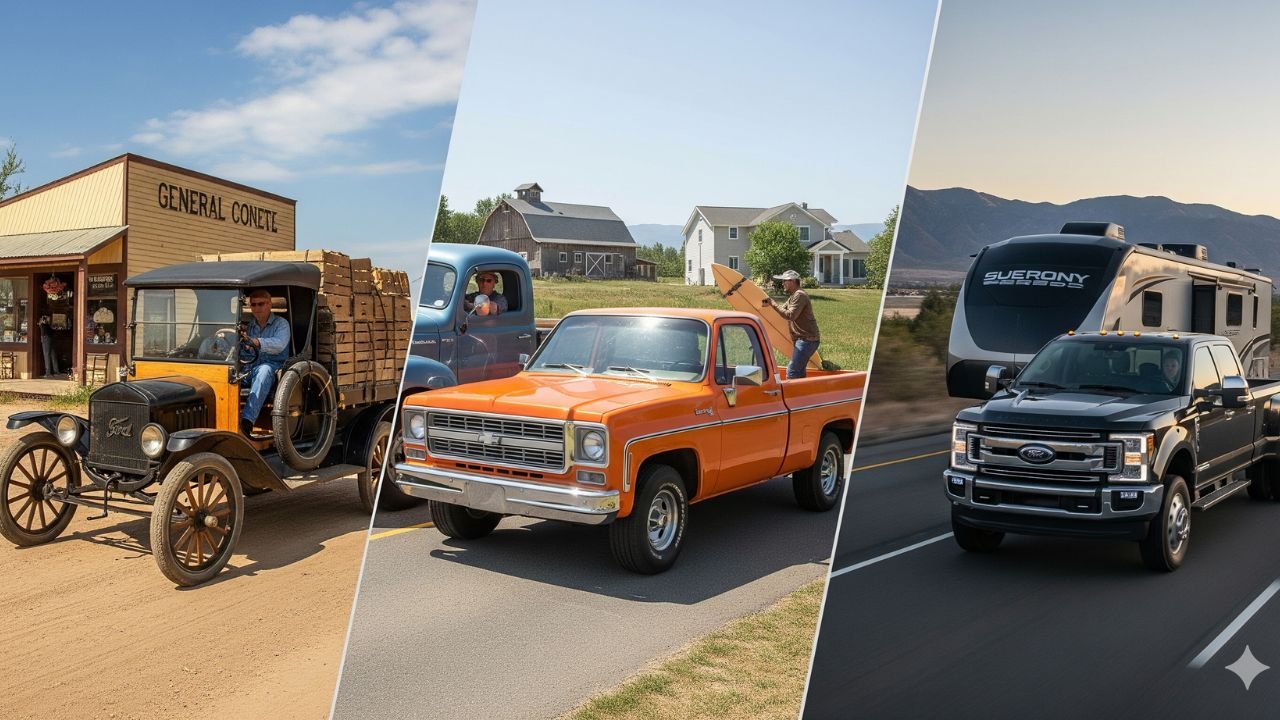
The Evolution of Trucks in the USA: A Journey Through Time

Hey there, truck enthusiasts. Have you ever wondered how those massive rigs on the highway or the trusty pickups in your neighbor’s driveway came to be? The evolution of trucks in the USA is a fascinating story.
It mirrors the country’s growth from rural farmlands to bustling cities and high-tech highways. Trucks aren’t just vehicles; they’re symbols of hard work, innovation, and American spirit.
We’ll take a casual stroll through history, from the first clunky inventions to today’s electric wonders. Whether you’re a history buff or just curious about what powers our economy, stick around. We’ll keep things straightforward and fun.
Let’s start at the beginning. Trucks didn’t appear overnight. They grew out of a need for better ways to haul stuff around. Back in the late 1800s, most freight moved by trains or horse-drawn wagons.
But as cities expanded, something faster and more flexible was needed. That’s where the early trucks stepped in.
The Early Days: Birth of the Truck (1890s-1910s)
Picture this: It’s the 1890s, and inventors are tinkering with steam-powered wagons. These were basically beefed-up carts with engines.
In 1896, a guy named Gottlieb Daimler built what many call the world’s first motorized truck. It had a 4-horsepower engine and could haul a bit of cargo.
But in the USA, things really kicked off in 1898 when Alexander Winton created the first semi-truck. He used it to transport cars from his factory without racking up miles on them.
By 1899, Autocar sold the first commercial truck in America. It could carry about 700 pounds, which doesn’t sound like much now, but it was a game-changer for local deliveries.
These early trucks ran on gasoline or even electricity in some cases. GMC got into the mix around 1902 with the Rapid truck, a simple one-cylinder beast sold to a laundry business.

As the 1900s rolled in, trucks started replacing horses in cities. They were quicker and didn’t need feeding.
Henry Ford’s Model T in 1908 made vehicles cheaper, and soon people modified them into pickups by adding wooden boxes to the back.
Farmers loved this DIY approach. It was affordable and practical for hauling crops or tools.
But challenges abounded. Roads were mostly dirt or gravel, so trucks needed sturdy builds. Solid rubber tires were common, but they made for bumpy rides.
By 1913, Ford’s assembly line cut costs, and states like Maine set weight limits at 18,000 pounds to protect those fragile roads.
Here are some key early milestones:
- 1898: First semi-truck by Winton for car transport.
- 1899: Autocar’s commercial truck hits the market.
- 1908: Ford Model T sparks widespread vehicle adoption.
- 1913: Assembly line production boosts affordability.
These steps laid the foundation. Trucks were no longer novelties; they were essential for business.
World War I and the Rise of Trucking (1910s-1920s)
World War I changed everything. The military needed reliable ways to move supplies, and railroads were jammed. Trucks stepped up big time.
By 1914, there were about 100,000 trucks on U.S. roads, mostly in cities. The war pushed innovations like pneumatic tires, which allowed heavier loads and faster speeds.
Companies like Mack and White Motor became household names for building tough military trucks.
After the war ended in 1918, surplus trucks flooded the civilian market. This sparked a boom. By 1920, over a million trucks were zipping around.

The 1920s saw more paved roads, thanks to the Federal Aid Road Act of 1916.
Trucks could now handle longer hauls. Diesel engines appeared, offering better fuel efficiency—up to 40% more than gasoline. Standardization of parts made repairs easier too.
Pickup trucks evolved separately but similarly.
Ford introduced the 1925 Model T Runabout with a factory-built pickup body. It was the first of its kind, blending car comfort with truck utility. Chevrolet followed suit, and competition heated up.
Trucking wasn’t just about work anymore. It became a viable alternative to trains for perishable goods. But with growth came issues like varying state regulations on weights and sizes.
The Great Depression and Regulations (1930s)
The stock market crash of 1929 hit hard. Many trucking companies folded, but survivors got creative.
The Great Depression forced efficiency. In 1933, Kenworth and Cummins rolled out the first diesel truck with a vertical exhaust stack. This made long-hauls more economical.
Government stepped in. As part of the New Deal, the trucking industry created a code of fair competition.
This led to the American Trucking Associations in 1933. Then, the Motor Carrier Act of 1935 gave the Interstate Commerce Commission power to regulate rates and routes.

Safety became a focus. The first hours-of-service rules in 1937 limited drivers to 10 hours behind the wheel. A big strike in New York City in 1938 pushed for better wages and shorter weeks, showing truckers’ growing voice.
Technologically, refrigeration advanced. Frederick McKinley Jones patented an automatic system in 1940, perfect for hauling food without spoilage. Pickups got comfier too, with better cabs and heating.
Despite tough times, trucking proved resilient. It kept goods moving when the economy needed it most.
World War II and Post-War Boom (1940s-1950s)
Here we go again—war. World War II ramped up truck production. By 1942, 125,000 truckers joined the effort. Trucks filled gaps left by strained rails, hauling ammo and supplies.
Freightliner introduced the Model 600 in 1942, with an aluminum cab for lighter weight and better efficiency.
After the war, America boomed. The Federal-Aid Highway Act of 1944 planned interstates, but real funding came in 1956 under Eisenhower. This network transformed trucking, allowing faster, longer trips.

Pickups reflected the era’s optimism. Ford’s F-Series debuted in 1948, with integrated designs and V8 options. Chevy’s Task Force series added style and power. Trucks weren’t just for farms; suburban families started using them.
In 1955, Malcolm McLean invented container shipping, making intermodal transport seamless. By the late 1950s, cab-over-engine designs improved access for mechanics.
Trucking became part of pop culture. Think of those classic ads showing trucks conquering tough terrains.
The Interstate Era and Technological Leaps (1950s-1970s)
With interstates underway, trucks grew bigger. The 1956 Highway Act set a 73,280-pound weight limit. This meant more cargo per trip, boosting efficiency.
The 1960s brought power boosts. Big V8 engines, better suspensions, and four-wheel drive became standard. Air conditioning? Yes, please. Models like Chevy’s C/K series catered to work and leisure.
Trucker culture exploded in the 1970s. CB radios let drivers chat, dodging “smokeys” (cops). Songs like “Convoy” and movies like “Smokey and the Bandit” romanticized the life.
But energy crises in 1973 and 1979 led to strikes over fuel costs.

Regulations evolved. The 1974 amendments raised weight limits to 80,000 pounds. Bridge formulas ensured safety on roads.
Here’s a quick table on weight limit changes:
| Decade | Federal Max Weight (pounds) | Key Reason |
|---|---|---|
| 1910s | 18,000-28,000 (state vary) | Road protection |
| 1950s | 73,280 | Interstate start |
| 1970s | 80,000 | Efficiency boost |
These changes helped trucking handle America’s growing economy.
Deregulation and Modernization (1980s-1990s)
The 1980s shook things up. The Motor Carrier Act of 1980 deregulated the industry, sparking more companies and lower rates. Competition grew, benefiting consumers.
Tech-wise, aerodynamics improved fuel efficiency. Electronic fuel injection and diesel engines cut emissions. Pickups like the Toyota Tacoma emphasized durability. Extended cabs added space for families.

In the 1990s, safety features like airbags and ABS brakes became common. Trucks got luxurious, with leather seats and stereos. The Surface Transportation Assistance Act of 1982 standardized sizes across states.
Cultural shifts saw pickups as status symbols. They appeared in ads towing boats or climbing mountains, appealing to adventure seekers.
The 21st Century: Electric and Smart Trucks (2000s-Present)
Fast forward to today. Trucks are smarter than ever. GPS, autonomous features, and telematics optimize routes. Electric models are stealing the show.
Think Tesla’s Cybertruck, Ford’s F-150 Lightning, and GMC’s Hummer EV. These promise zero emissions and instant torque.
Environmental regs push for cleaner tech. Hybrids and hydrogen are on the horizon. By 2025, autonomous trucks are testing on highways, potentially reducing accidents.

Pickups now boast infotainment screens and driver aids. Sales hit over three million last year, used for everything from work to weekend getaways.
But challenges remain, like supply chain issues and rising fuel costs. Still, trucks keep evolving.
Key Manufacturers and Iconic Models
No truck story is complete without the big players. Ford pioneered with the Model T and F-Series, America’s best-seller for decades. Chevy’s Silverado line offers power and reliability. Dodge (now Ram) brought muscle with the Power Wagon.
Mack Trucks specialized in heavy-duty rigs, while Freightliner focused on semis. GMC added luxury touches to pickups.
Iconic models:
- Ford F-150: Versatile king since 1948.
- Chevy C10: Classic 1960s style.
- Tesla Cybertruck: Futuristic electric beast.
These brands shaped the industry.
Cultural Impact of Trucks in America
Trucks are more than machines. They represent freedom and grit. In movies, they’re heroes outrunning the law. On farms, they’re lifelines. In suburbs, they signal success.

From cowboy ads to monster truck rallies, trucks embody American values. Even when empty, they carry a story of hard work.
Future Trends in Truck Evolution
Looking ahead, sustainability is key. Electric and autonomous tech will dominate. Expect lighter materials, better batteries, and AI for safety.
Trucks might integrate with smart cities, optimizing traffic. But they’ll always haul our stuff and dreams.
FAQs About The Evolution of Trucks in the USA
Q. When was the first truck invented in the USA?
A. The first commercial truck was built and sold by Autocar in 1899, with a payload of about 700 pounds. It marked the start of motorized freight transport.
Q. How did wars influence the evolution of trucks?
A. World Wars I and II boosted truck use for military logistics, leading to advancements like pneumatic tires, diesel engines, and stronger builds. Post-war surpluses accelerated civilian adoption.
Q. What are the latest trends in trucks as of 2025?
A. Electric trucks like the F-150 Lightning are gaining traction for eco-friendliness. Autonomous driving and advanced safety tech are also big, aiming for efficiency and reduced emissions.
Conclusion
We’ve covered a lot, from steam wagons to electric pickups. The evolution of trucks in the USA shows how innovation meets necessity. As we move forward, trucks will keep adapting, powering our lives. Thanks for joining this ride.
Disclaimer: This article is for informational purposes only and based on historical sources. Always verify facts for professional use.