
The Evolution of Tractors in the USA: From Steam Engines to Smart Machines

Hey there, fellow history buffs and farm enthusiasts. Have you ever stopped to think about how a simple machine like a tractor completely changed the face of American farming?
Picture this: back in the day, farmers relied on horses and sheer muscle power to till the soil. Fast forward to today, and we’ve got high-tech beasts that can plant, harvest, and even drive themselves.
We’ll take a friendly stroll through the evolution of tractors in the USA. We’ll cover the key milestones, the game-changing innovations, and how these machines shaped our nation’s agriculture.
Whether you’re a weekend gardener or a full-time farmer, there’s something here for you. Let’s get started.
The Dawn of Mechanized Farming: Steam Tractors
The story kicks off in the mid-1800s, when steam power started to make waves in American agriculture.
Before tractors, farming was all about draft animals like horses and oxen. But steam engines promised something new: raw power without the need for hay or stables.
The first steam-powered farm engines showed up around 1868. These were basically small locomotives on wheels, used for hauling timber or plowing fields. They were operated by one person if they weighed under five tons.
Companies like Garrett built popular models, but these early machines had their drawbacks. They were heavy, clunky, and always at risk of sparking fires in dry fields.
By the 1870s, portable steam engines were common for tasks like threshing grain. Farmers would tow them with horses, then use belts to power other equipment.
In the 1880s, self-propelled steam traction engines arrived, marking a big step forward. Production ramped up, with around 4,000 units made annually by the early 1900s.
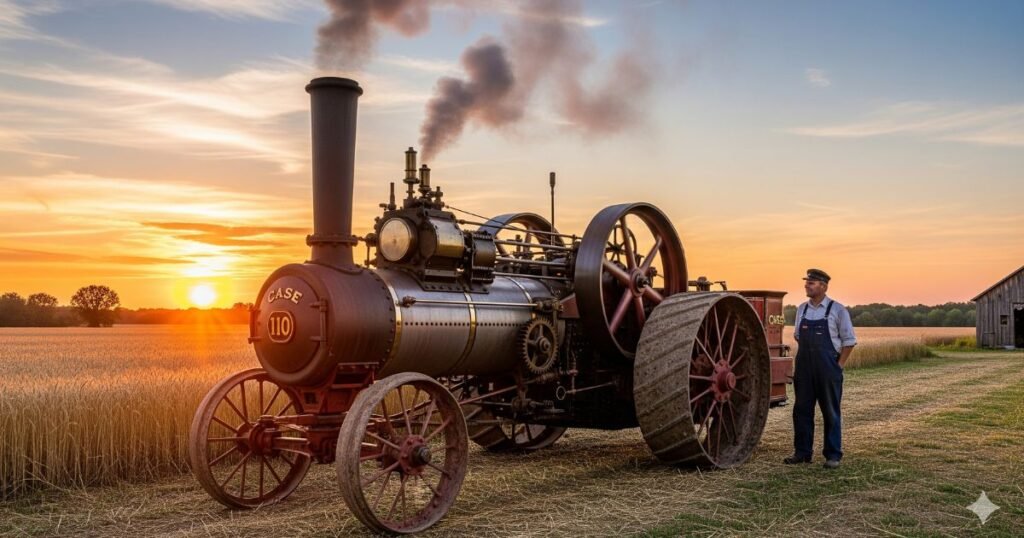
Steam tractors boosted efficiency on large farms, especially in the Midwest where wheat fields stretched for miles. But they were expensive and hard to maintain.
Plus, on wet or uneven ground, they often got stuck. Still, they laid the groundwork for what was coming next.
The Birth of the Gasoline Tractor
As the 19th century wrapped up, inventors tinkered with internal combustion engines. Gasoline offered a lighter, more reliable alternative to steam. This shift happened right here in the USA, with Iowa playing a starring role.
In 1892, John Froelich built the first successful gasoline-powered tractor in Clayton County, Iowa.
He mounted a single-cylinder engine on a steam engine chassis. That fall, it threshed over 72,000 bushels of grain without a hitch. Froelich’s machine was a hit, but sales were slow at first.
Enter Charles Hart and Charles Parr. In 1901, they coined the term “tractor” for their two-cylinder gasoline model in Charles City, Iowa.
By 1903, they had built 15 units. Around the same time, the Charter Gasoline Engine Company in Illinois experimented with gas engines on traction chassis.
These early gasoline tractors were simpler than steam ones. They didn’t need constant water refills or coal.
Farmers could start them quickly and use them for plowing, hauling, and more. By 1910, companies like International Harvester jumped in, producing models like the Titan.
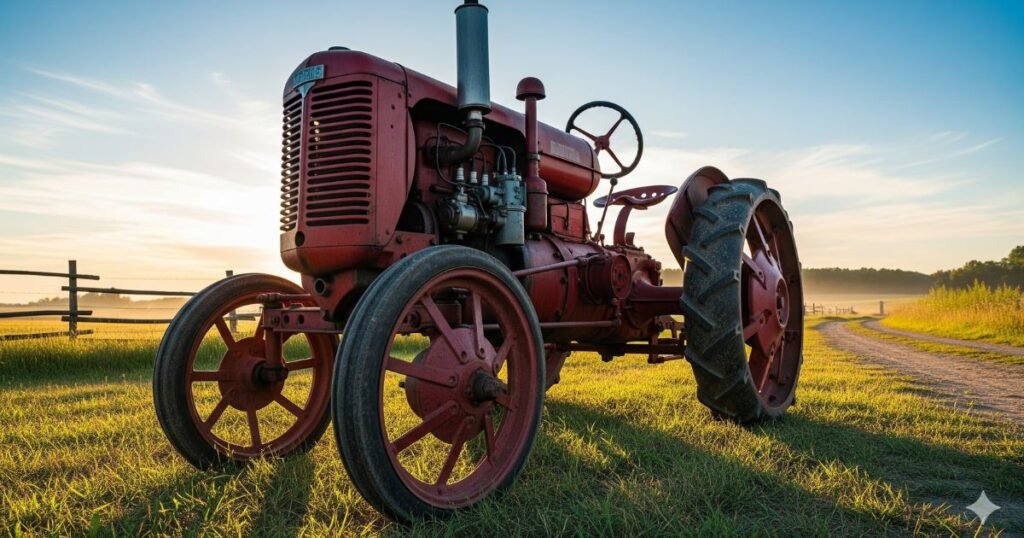
But challenges remained. Engines were unreliable, and fuel systems prone to issues. Yet, gasoline tractors spread fast, especially during World War I when labor shortages hit farms hard.
Here’s a quick look at early pioneers:
- John Froelich: 1892, first gasoline tractor prototype.
- Hart-Parr: 1901, introduced the word “tractor.”
- Charter Engine Co.: 1889, early gas traction engines.
These innovators set the stage for mass adoption.
The Roaring Twenties: Mass Production and Innovation
The 1920s were the golden age for tractors. With the war over, farmers needed efficient tools to meet rising food demands. Enter Henry Ford, the auto king, who applied assembly-line magic to tractors.
In 1917, Ford launched the Fordson, the first mass-produced tractor. It was affordable, lightweight, and powerful enough for small farms.
By 1921, Ford sold 36,000 units, capturing 75% of the market by 1923. The Fordson made tractors accessible to average farmers, not just the wealthy.
Competition heated up. International Harvester rolled out the Farmall in 1924, the first row-crop tractor. It could navigate between crop rows, perfect for corn and cotton. This design revolutionized planting and cultivating.
John Deere entered the fray with the Model D in 1923, a reliable two-cylinder workhorse that stayed in production for nearly 30 years.
Allis-Chalmers and others followed suit, adding features like power take-offs (PTOs) for running attachments.
Tractor numbers exploded. In 1916, about 20,000 were sold in the US; by 1935, over a million were in use. Farms grew larger as one tractor replaced multiple horses.
| Era | Key Tractor Models | Innovations |
|---|---|---|
| 1910s-1920s | Fordson, Farmall, John Deere Model D | Mass production, row-crop design, affordable pricing |
This table shows how quickly things advanced. Farmers could now cover more ground in less time.
Diesel Power and Wartime Advances
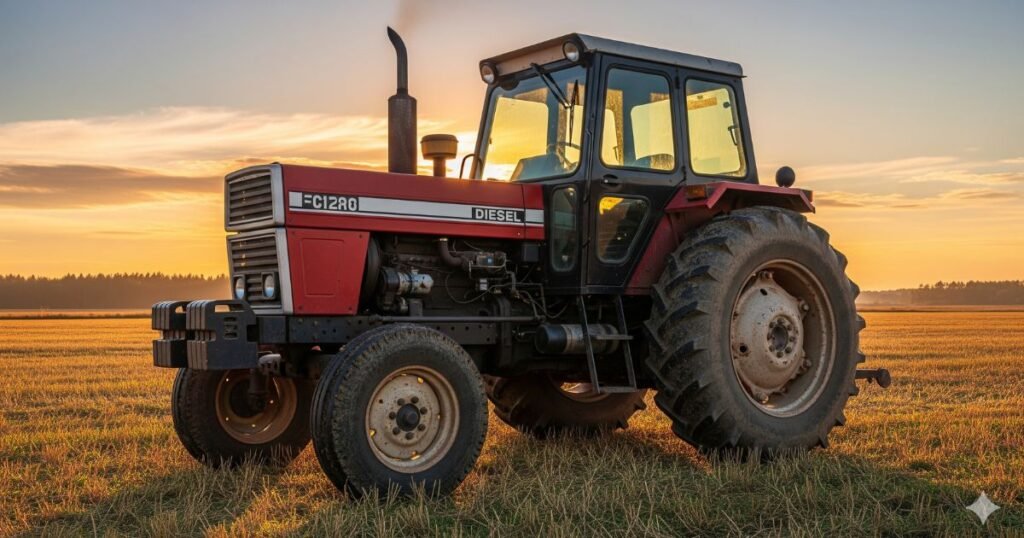
The 1930s brought economic hardship with the Great Depression, but tractor tech pushed forward. Diesel engines emerged as a game-changer, offering better fuel efficiency and torque.
Caterpillar led with diesel models in the mid-1930s, like the RD series. Diesel was cheaper than gasoline and provided more power for heavy tasks.
By the late 1930s, rubber tires replaced steel wheels, improving traction and reducing soil compaction.
World War II accelerated innovation. With men off to war, farms relied on machinery.
The government encouraged tractor use to boost food production. Post-1930s models featured hydraulics for lifting implements easily.
International Harvester’s Farmall M and John Deere’s Model A became icons. These tractors had three-point hitches, inspired by Harry Ferguson’s system, which Ford adopted in 1939. This allowed better control of plows and other tools.
Despite the Dust Bowl’s challenges, tractors helped reclaim land. They enabled contour plowing to prevent erosion. By war’s end, diesel dominated, setting the tone for modern farming.
Post-War Boom: Modern Features
After 1945, American agriculture boomed. Soldiers returned, but many stayed in cities, leaving farms short-handed. Tractors filled the gap with more advanced designs.
The 1950s saw bigger, more powerful machines. John Deere’s 4020 in 1963 offered over 100 horsepower, with options for cabs and air conditioning. Allis-Chalmers experimented with fuel cells, though they didn’t catch on.
Hydraulic systems and PTOs became standard. Tractors now powered balers, combines, and loaders. Four-wheel drive appeared, like in the Wallis models acquired by Massey-Harris.
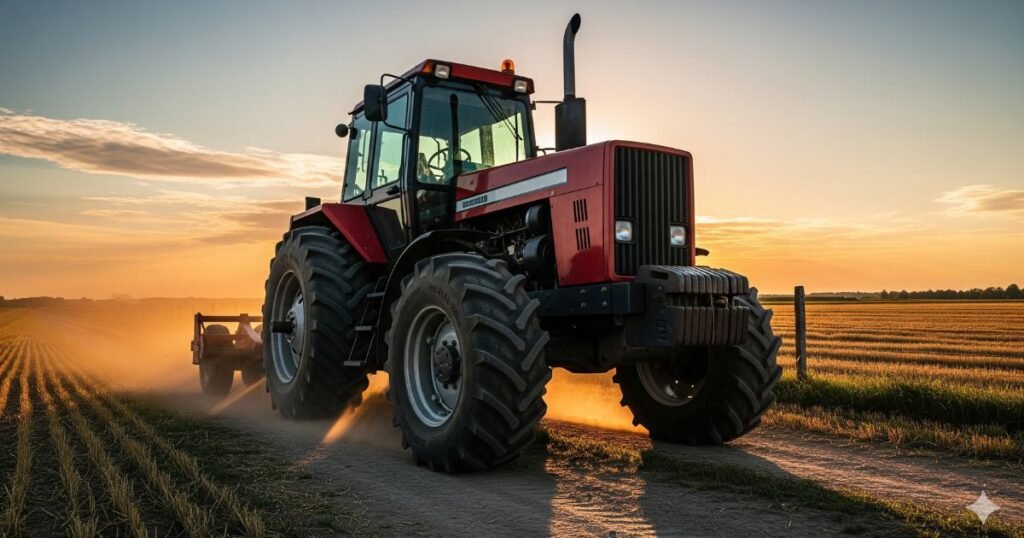
The 1960s and 1970s focused on comfort and safety. Enclosed cabs protected operators from weather and dust. Turbocharged engines boosted power without bigger sizes.
By the 1980s, electronics entered the picture. Digital displays monitored fuel and performance. Companies like Case IH introduced the Magnum series with advanced transmissions.
Tractors helped consolidate farms. Average farm size grew from 174 acres in 1950 to over 400 by 1980. Fewer farmers fed more people, thanks to these machines.
- Increased horsepower for larger fields.
- Better ergonomics for long hours.
- Versatile attachments for multiple tasks.
This era turned farming into a high-tech business.
The Digital Age: Smart Tractors
Fast forward to the late 20th century, and tractors got smart. GPS technology arrived in the 1990s, enabling precision agriculture. Farmers could map fields, apply fertilizers exactly where needed, and reduce waste.
John Deere’s GreenStar system in 1994 was a pioneer. It used satellite data for auto-steering, cutting overlap and saving fuel.
By the 2000s, autonomous features emerged. Tractors could follow pre-set paths without constant input.
Today, brands like Fendt and Kubota prototype electric and battery-powered models.
Monarch Tractor offers fully electric units for vineyards, cutting emissions. AI and IoT integrate, with sensors tracking soil health in real-time.
Drones pair with tractors for aerial scouting. Big data analytics predict yields. In 2023, over 60% of new tractors had automation tech.

These advancements make farming sustainable. Less fuel use means lower carbon footprints. Precision reduces chemical runoff, protecting waterways.
Impact on American Agriculture
Tractors didn’t just change machines; they transformed lives. Before tractors, one farmer fed about 25 people.
Now, it’s over 160. Productivity soared as tractors freed up land once used for horse feed—about 25% of farmland.
Rural America shifted. Farms consolidated, leading to fewer but larger operations. This spurred urbanization, as displaced workers moved to cities for factory jobs.
Economically, tractors boosted output. During WWII, they helped feed allies. Post-war, exports grew, strengthening the US economy.
Socially, they eased backbreaking labor. Women and older folks could operate them, diversifying the workforce. But challenges arose, like overproduction leading to price drops.
Environmentally, early tractors compacted soil, but modern ones with low-pressure tires mitigate that. Overall, tractors made American ag the world’s most efficient.
Looking Ahead: Future Trends in Tractors
What’s next for tractors? The future looks electric and autonomous. By 2030, electric models could surge, driven by sustainability goals. Companies like John Deere and Solectrac are testing plug-in tractors.
AI will play a bigger role. Imagine tractors predicting breakdowns or optimizing routes via machine learning. IoT will connect fleets for seamless operations.
High-horsepower autonomous tractors will dominate large farms. In 2025, trends point to more subsidies for green tech. Compact electric tractors for small holdings will rise.
Challenges include high costs and infrastructure for charging. But with falling battery prices, adoption will grow. The US tractor market, worth billions, will focus on efficiency and eco-friendliness.
FAQs About The Evolution of Tractors in the USA
Q. What was the first tractor invented in the USA?
A. The first successful gasoline-powered tractor was built by John Froelich in 1892 in Iowa. It used a single-cylinder engine and proved reliable for threshing grain.
Q. How did tractors change farm sizes in America?
A. Tractors allowed farmers to manage larger areas with less labor. Average farm size doubled from the 1950s to the 1980s, leading to more efficient production.
Q. Are electric tractors the future?
A. Yes, they’re gaining traction for their low emissions and quiet operation. Models from Monarch and Fendt show promise, especially for specialty crops.
Conclusion
From steam-powered giants to AI-driven wonders, the evolution of tractors in the USA is a tale of ingenuity and progress. These machines turned rugged frontiers into bountiful heartlands, feeding a nation and beyond.
As we look forward, tractors will keep adapting, helping farmers meet new challenges like climate change. It’s exciting to think about what’s next.
Disclaimer: This blog is for informational purposes only and based on historical and current trends. Always consult experts for farming advice or equipment purchases.


